Monitoring and Evaluation Report
April 1st, 2023 till March 31st, 2024
H.EL.P. Human Elephant Peace Program – Myanmar
Elephant safety education and seasonal electric crop fence training in Myanmar
GBP Grow Back for Posterity – Myanmar Aung Myo Chit
Compass Films – France – Klaus Reisinger
This report is an evaluation of the project “Human Elephant Peace” that has been implemented under USFWS grant F19AP00359-3, Darwin Initiative grant # 27-012. Match funding for the project was provided by BAT – U.K., Elephant Family – UK and Shared Earth foundation – U.S.A. which is being i from 8 April 2021 till July 2024 across Rakhine state, and Yangon, Ayeyarwady and Bago division.
Due to political tensions, project activities were refocused on Yangon, Ayeyarwady, Rakhine and Bago division HEC (Human Elephant Conflict) instead of Maygway and Mandalay areas in our initial proposal, without any impact on scope or target numbers, resulting only in a shift to an alternate location.
The methodology used in the evaluation of this project was conducting surveys amongst project participants and gathering date on various parameters through interviews, field records by GBP staff and records compiled by villagers.
1. H.EL.P. Elephant Safety education workshops:
1.1 In Year 3 the following H.EL.P. education materials were produce. 2000 Elephant Memory games, 4,000 education booklets and 4,000 fencing booklets were printed on 8th April 2023 to be used in education and fence training workshops.
1.2 GBP staff was trained in the field to improve their training capacity by education and fence team leaders as well as GBP director Aung Myo Chit. This is an ongoing process to ensure staff is at its best performance.
1.3 Engagements with school officials and higher education partners consisted of meetings and presentations about our activities with 313 school heads (Male-50,Female-263) and 1 rector(Male-1) and 1 pro-rector (Male-1), 10 professors (Female – 10) from Pathein university. Teachers present at during school education programs participated as well in the workshops. Four university students from Pathein University have joined the GBP teams to for data collecting on patrolling trip every month. They are also entering data in the GBP online database.
1.4 From 2020 to 2024 a total of 32,727 people were reached by the H.EL.P. safety education team in four different regions, 2,567 male students and 2,666 female students and community 12813 male and 14,060 female adult community members and 612 officials. Out of these participants 2,488 were surveyed, which represents a sample rate of 7.6 percent.

1.5 General survey strategy:
To measure the impact of elephant safety education conducted under log frame section we used pre workshop and post workshop multiple choice surveys to compare understanding of the various subject maters before and after the safety presentations.
Most of the survey work took place in schools and trainings, however during Covid 19 restriction, we could not gather survey data in 2020 to 2021 due to social distancing rules. Starting from late 2022, we were able to once again do regular surveys during our H.EL.P. elephant safety education workshops.

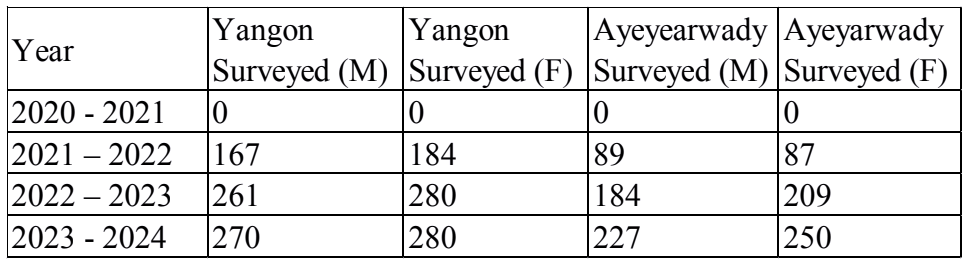
As community members gathered for the presentation, randomly chosen participants were asked to respond to the pre-workshop survey, addressing twelve important key points pertaining to the behavior of the elephant and knowledge of the person on elephants, coinciding with subject sections in the curriculum. See Annex for the Survey forms. After that, H.EL.P. safety workshops were conducted by the GBP team, and followed by post-survey questions with the same people and survey subjects. This provides us a direct indicator of knowledge increase due to our education program. We also separately analyzed first time exposure to H.EL.P. elephant safety education comparing it to the same community on repeat visit, to gauge the impact of
1.6 Yangon division:
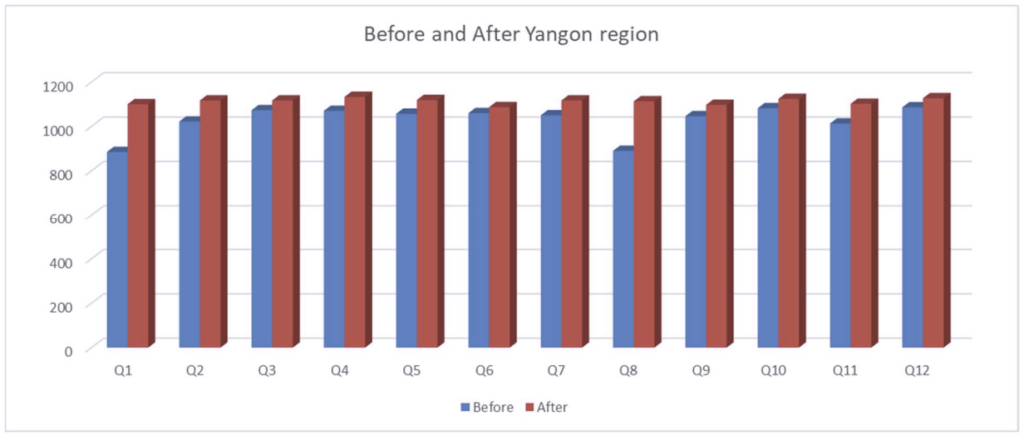
A total of 1160 people were surveyed for pre and post education surveys and the average result showed an average of 5% increase in understanding after the workshop.
The pre-workshop evaluation results in Yangon division show an average of 85% of the respondents chose the correct answer before the workshop, which indicates an already high understanding of the subject matter.
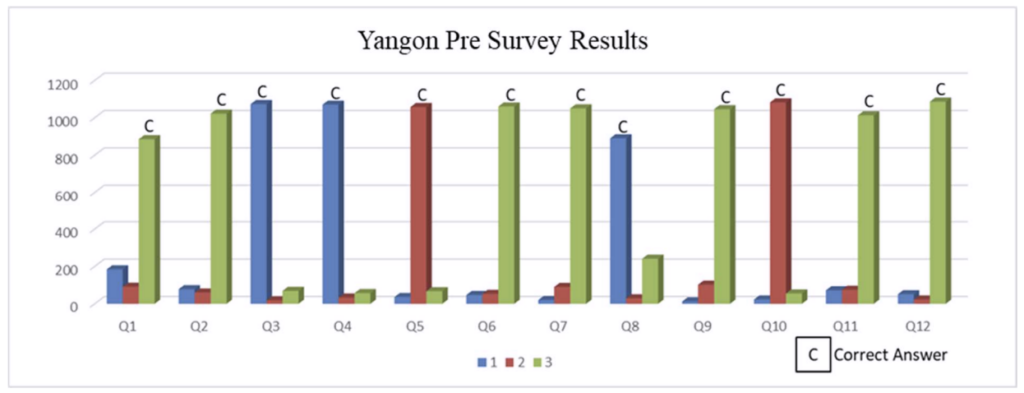
However, the pre-workshop results show that the respondents have weaknesses of understanding in Q1 and Q8. Q1 concerns the safety measure that need to be taken if a wild elephant enters a village (a). Prepare platforms (b). Prepare a fence and (c). Both. The correct answer is (c). Q8 concerns the roles intelligence of elephants. People underestimate the elephant’s intelligence, which leads to unsafe behavior by villagers. Lower-than-average understanding was observed in Q2 which addresses safely storing food and Q11 concerns the importance of forests for animals and humans. We adapted our education team’s focus to ensure additional effort is made to address subject matters relating to Q1 and Q8 primarily and Q2 and Q11 as well.
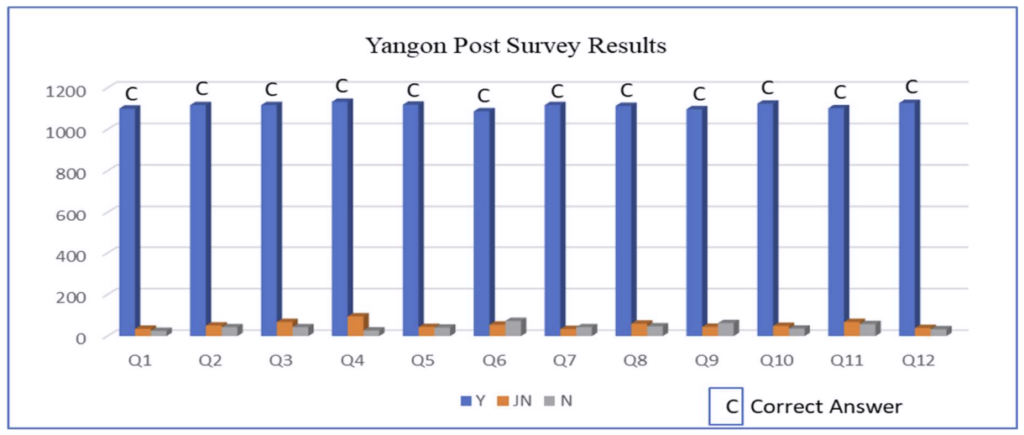
The results of post survey showed that despite of an already high knowledge, there was an average increase in the understanding of all topics amongst the respondents from 85% to 90% in understanding after the education. Specifically the post workshop result show that the understanding of Q1 increased 28% and Q8 and 25%. Understanding of Q2 and Q11 increased 9% after the safety education workshop.
Ayeyarwady division:
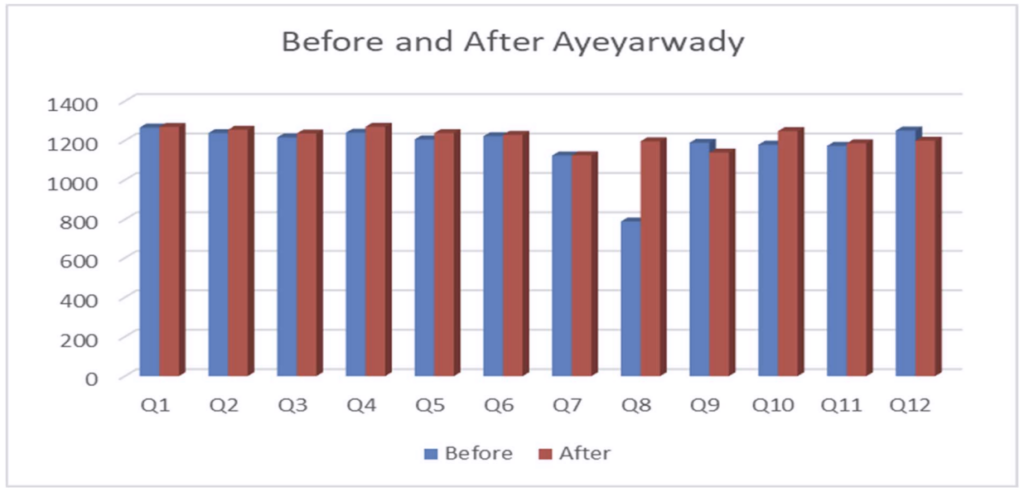
The survey was conducted in the same fashion for participants at the Ayeyarwady education implementation sites. A total of 1328 participants were surveyed in Ayeyarwady from 2022 to 2024. An average of 89% of the respondents managed to answer the correct answer for the multiple choice pre survey which indicates a higher existing pre workshop understanding than in Yangon division. The weakest knowledge is found at Q8, which is the same issue as in Yangon, showing low comprehension by people of the elephant’s level of intelligence. This subject area will need to be addressed in more detail with the communities in the future.
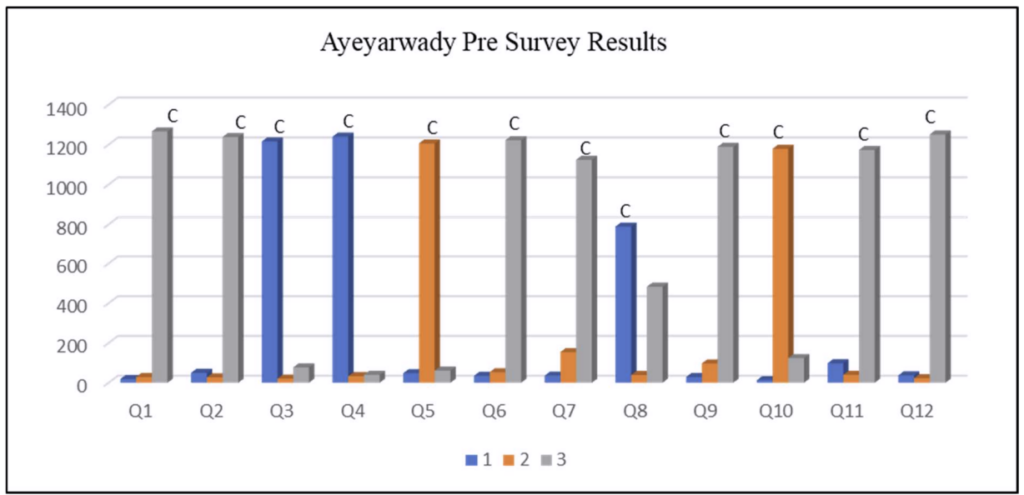
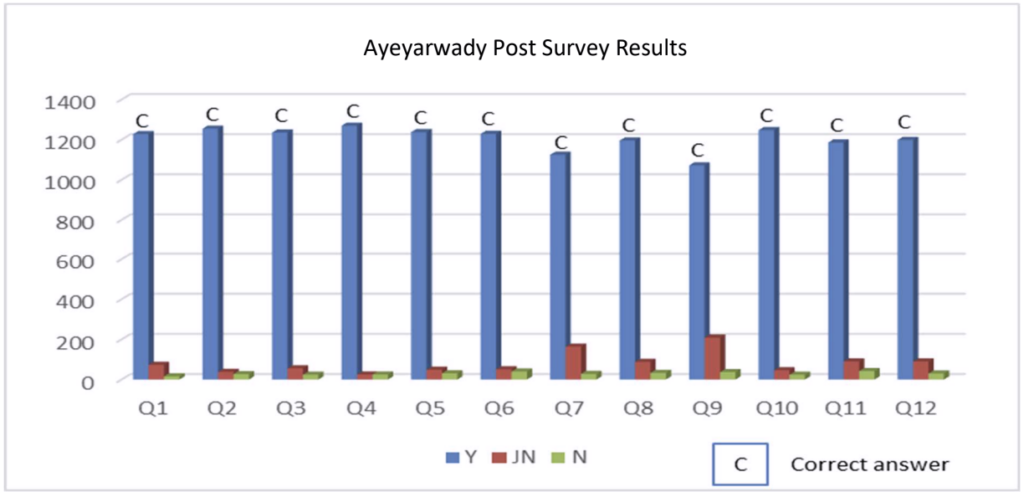
The data shows that Ayeyarwady communities despite their higher initial understanding about elephants were still able to improve on all topics from 89 % to an average of 92%, which corresponds to increase of 3% in understanding, after having participated in the education program. Ayeyarwady communities has higher understanding on safety management than Yangon, poor knowledge is apparent for Q7 about legal punishment for elephant poaching, Q8 concerning the level of intelligence of elephants, Q9, the role and importance of elephants, Q1, the importance of forest for both animals and humans and Q12, the necessity to protect elephants. Additional training will be required on these 5 subjects in the future. Especially Q9, and Q11 need attention, as a decrease of understanding is apparent, indicating that training methods on these two subject matters are inadequate and must be improved to avoid confusing the audience. Specifically the post workshop result show that the understanding of Q8 increased 15%.
1.7 539 elephant sightings were reported this year by farmers in the project area. Most elephant sighted at fence sites were approaching the perimeter from wooded or bushy vegetation sides, rarely from the open field areas. This supports our advice to farmers to avoid setting up fences along forested areas and dense bamboo or bushes. If unavoidable it is best to stay at a distance of 15 feet 5 meters from the vegetation to be able to clearly spot with a flashlight when guarding at night any elephants approaching the area. This is not always possible and contributes to possible fence damage. Any fence breakages and incursion into fenced areas, are directly linked to malfunctioning fences due to improper use or lack of maintenance. We are able to avoid repeat incursions by providing reinforcement training to farmers as soon as a incursion is reported, to ensure the fence is maintained to standard at all times.
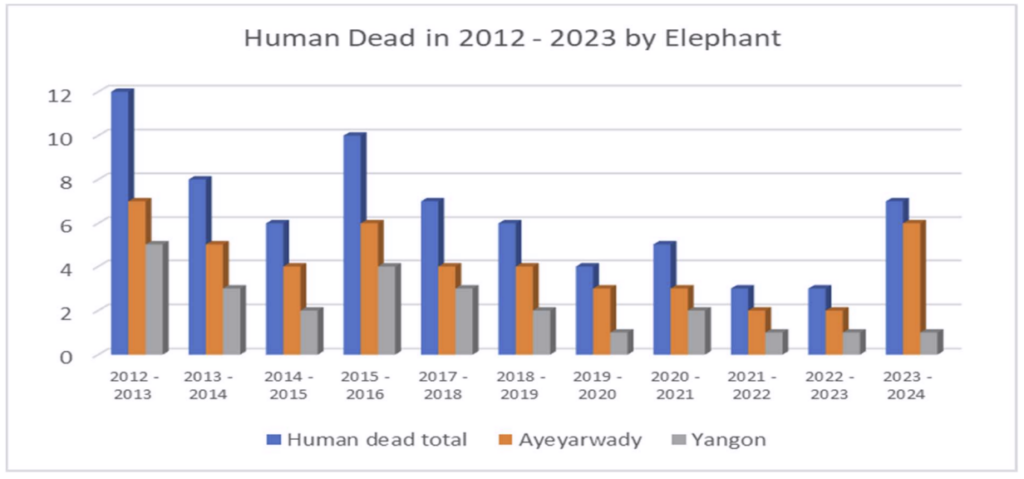
One of the fundamental indicators of impact for the H.EL.P program are the numbers of humans killed by elephants and elephant killed by humans. Two elephants died during the first three quarters of 2023 in two different townships: one in Ayeyarwady division, Ngwe Hsaung township and one in Yangon division, Thaikkyi township. One female elephant, age around 30 died in Thaikkyi township in Yangon, killed by inverter electric fence on 15th October 2023. The person responsible was taken into police custody. He knowlingly used a deadly inverter and therefore faces severe punishment. In Ayeyarwady one five year old female drowned in Bawmi creek on 21st November, 2023, considered a natural death in Tharpaung township. Fourth quarter of Darwin Y3, one elephant of 43 years old male elephant died naturally in January 29,2024. Only on death was caused by HEC or human intervaention and should be considered.
The information were reported by the farmers to GBP regular patrol team leader. All deaths occured outside our project areas, so we do not have a direct impact on these events. Nevertheless, the government officials after receiving training from GBP are able to distinguish between an illegal and premeditated killing of an elephant at a fence using a deadly inverter instead of an energeizer and the electric fences of our program. We constantly monitor any new improvised fences, and verify the technology used. If danger is imminent we ask the farmer to diconect the equipment and join our training course. Then we assist the farmer to bring his improvised fence up to required standards. The spilke of dead elephats in early 2023 can be attributed to a sudden increase in poaching following th ereopening of international borders, particularly China at the end of COVID 19. These deaths occured outside our immediate project area, so we readjusted our schedule and counteracted by sending education teams to the area to raise awareness and targeted antipoaching outreach. This paid off and poaching numbers dropped back to zero later this year, with villagers less likely to colude in criminal activities after participating in our H.EL.P elephant safety workshops. A 3 million Kyats, 1000 pounds reward for information leading to the arrest of poachers was set up. The simple announcement discouraged poachers and no further cases were reported. Numbers stabilized in a downward trend in 2023.
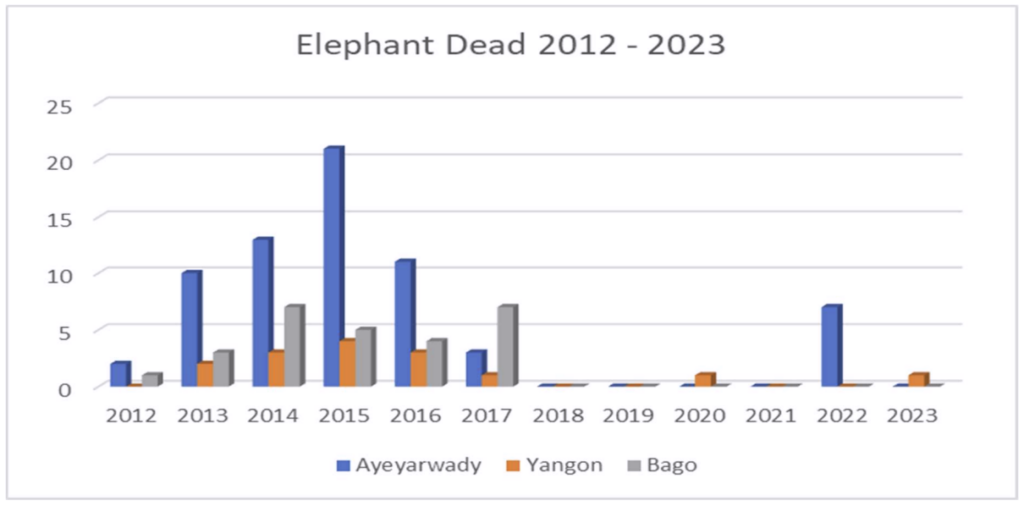
8 people died in 2023-2024 by elephants in Ayeyarwady and Yangon. One man in our project area and 5 men outside in Ayeyarwady and 2 men died outside of our project area in Yangon. Most of the men in Ayeyarwady were drunk, walking at night in areas where elephants regularly roam. One man in Yangon was killed by an elephant at dawn as he collected cashew nut in his orchard. A second man by accident walked straight up to an elephant in a village and was killed, while others were trying to alert him. This indicates that there are additional villages in Ayeyarwady that would benefit in the future from H.EL.P. educational workshops to raise awareness, especially about personal responsibility when living in wild elephant areas. Only one of 8 deaths overall occurred in project areas, underlining the importance of community education.
1.8 GBP Myanmar and Compass Films France consult every three days in average about latest developments with education and fence training activities. We discuss strategy and measures to be taken if any problems are encountered, education that needs reinforcement, and any other urgent or long term issues.
1.9 End of March early April 2024 Compass Films and GBP held a 4 day meeting in Thailand to discuss project development and needs for the education and fence training campaign. The need of additional training videos was discussed, as well as the expansion and continuation of all programs
2. H.EL.P. Seasonal electric crop fence training:
2.1 – 2.2 Nothing to report as Sri Lanka field visit was canceled in Y1
2.3 The H.EL.P. fence training manual is now available in Myanmar print version and in English soft copy, which was adapted in 2023 for a H.EL.P. Nepal seasonal electric crop fence training pilot conducted under USFWS match funding. See Annex
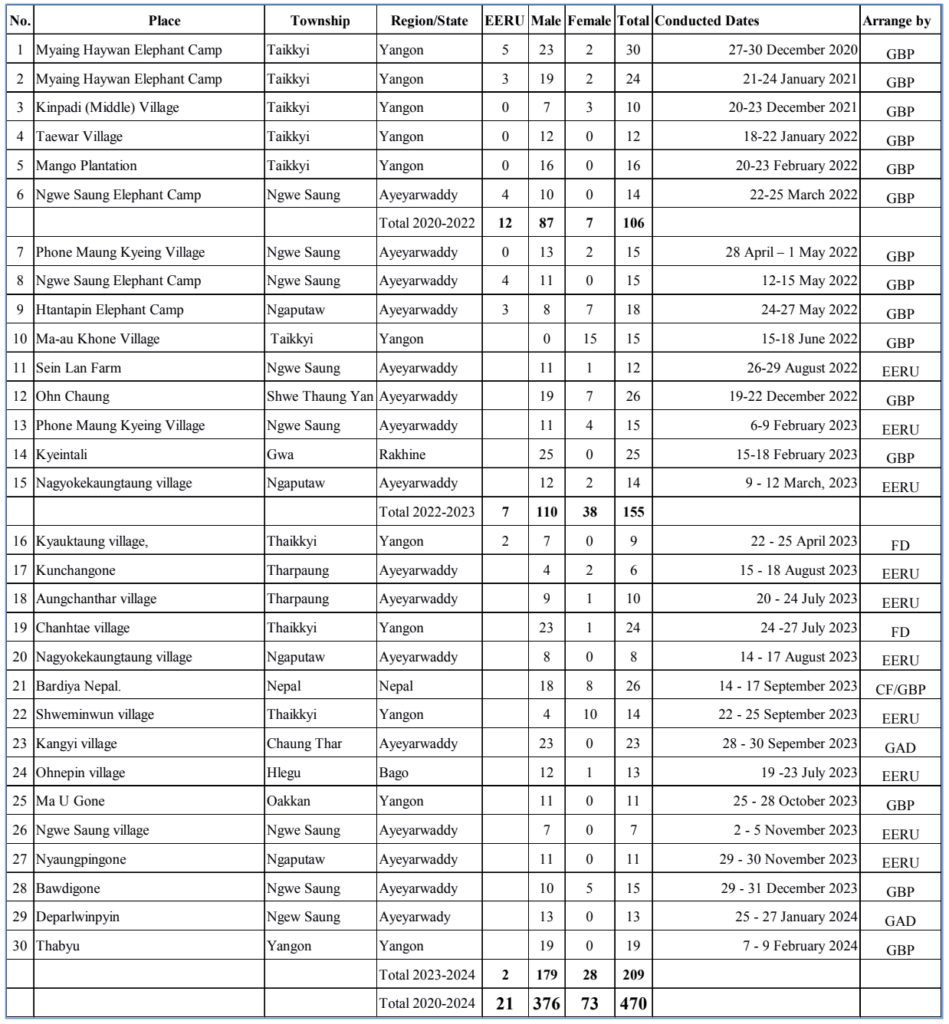
2.4 The fence training project objective was to train villagers how to protect their fields by safely installing, operating and removing seasonal electric crop fences. We had estimated at initial project design to train large numbers of people, of which only few would get actually certified and pass final examination to become basic electric fence technicians. With COVID 19 and associated distancing rules, we were restricted to limit participant numbers for each workshop to 15. The unexpected benefit of this obligation forced the GBP. H.EL.P. fence training team to preselect candidates and only admit villagers for training with a real need for an electric fence and sufficient motivation and positive attitude to succeed the training course. Therefore our initial expected certification rate of 30 percent of all participants actually improved to de-facto 100 percent. So far we trained 470 people, 26 of which were in Nepal for a pilot knowledge transfer of the fencing program. 21 government officials, 376 male and 73 female villagers, about half of our initial expected participants of 1080 at project end. But 100% instead of only 30% of all participants were certified. Therefor we already overachieved on the initial target of 324 of total certified trainees by 45%, with still 4 months to go till project end in July 2024.
In each area interested by receiving fence training to protect crops we start out by GBP providing H.EL.P. safety education workshops first to ensure people have the required basic and fundamental understanding about elephants. Then the GBP/H.EL.P. fence training team takes over and selects 10 to 20 people to participate in fence training.
Part of the programs objective was to institutionalize the program activity, provide ToT for government staff and for them to continue fence training autonomously, making it part of official government strategy to reach HECx (Human Elephant Coexistence). Our H.EL.P program achieved these goals for Yangon and Ayeyarwady.
30 fence training courses were held under this program since 2020, in 4 regions, with the main focus on Ayeyarwady and Yangon and few additional trainings in Rakhine and Bago. 51 female and 257 male villagers and 19 government trainees were certified by GBP, while 29 female and 114 male were certified by GBP trained Forrest Department and EERU (Elephant Emergency Rescue Unit) training staff.
GBP will need to monitor FD and EERU training activities, fence installations and extend villager training and ToT of government officials to other regions in the coming years under a planned new Darwin and USFWS funding requests.
2.5 Survey forms were used for each of the fence training participants before the 4 day workshop to establish understanding of their actual need to protect crops and houses, and their perception of the elephant presence. These surveys led us to gain valuable insight on their attitude towards the elephant problem, and practical needs that would need to be addressed in our training programs to improve or enable coexistence. A total of 444 Myanmar fence training participants were surveyed plus 22 additional villagers during meetings and workshops: Female 89, Male 377 from three different areas Yangon, Ayeyarwady and Rakhine.
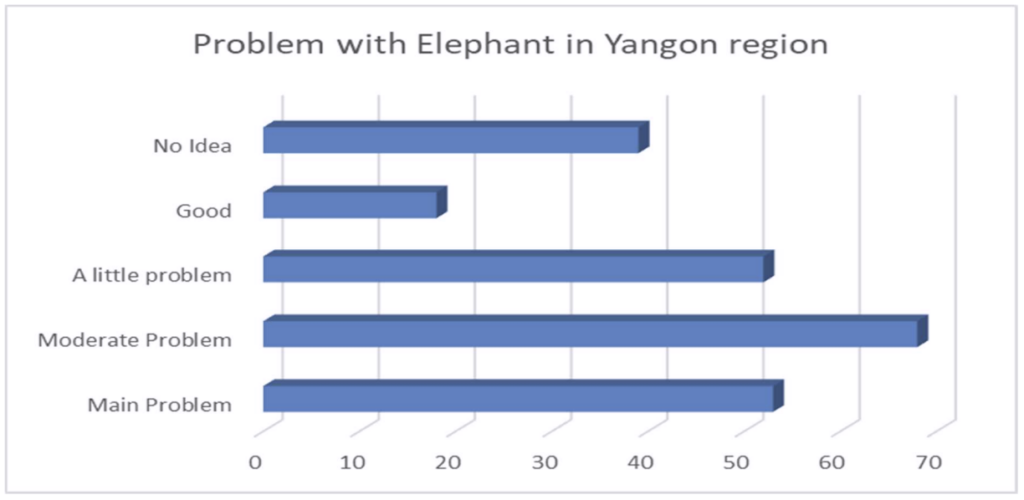
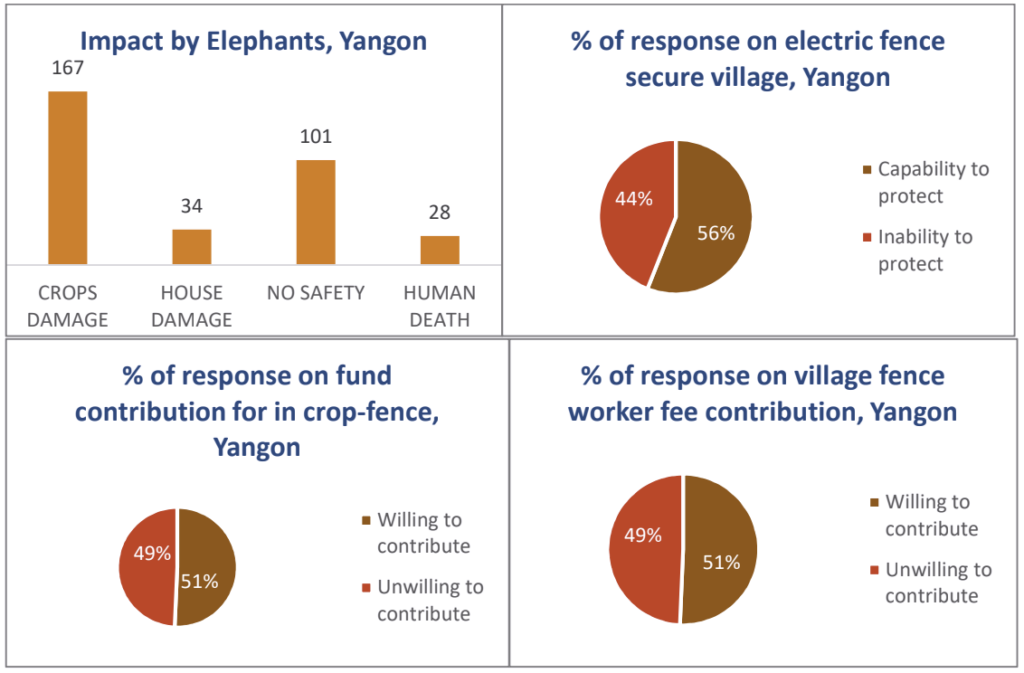
In Yangon region, 240 respondents female 67, male173 were surveyed and most noted there was a moderate problem with elephants and the damages caused by the elephants were primarily damage to crops, followed by perceived lack of safety, damage to houses and death. In order to mitigate these negative impacts, at least half of the respondents agreed that electric fences would secure their villages and assets and were willing to contribute their own funds and labor. The rate of confidence in the fences potential was lowest in Yangon with only 56% and readiness to contribute 51%.
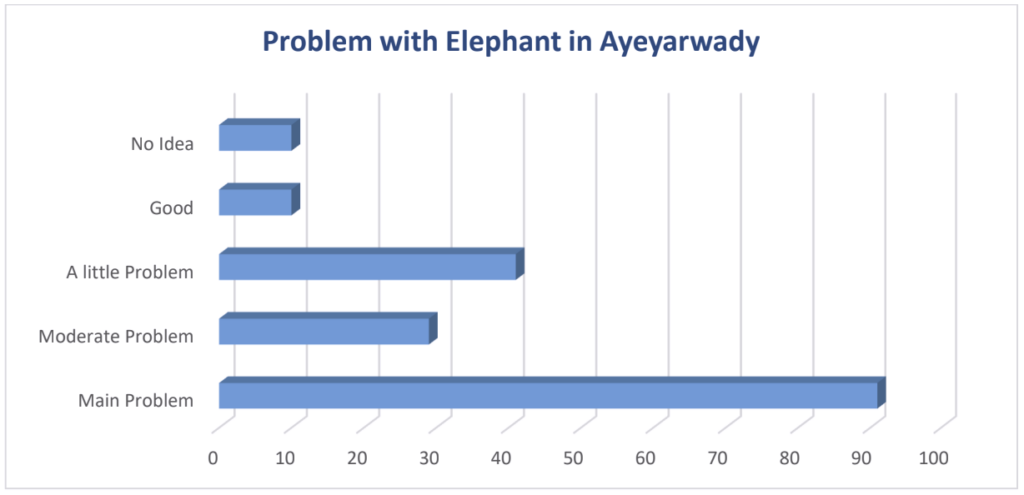
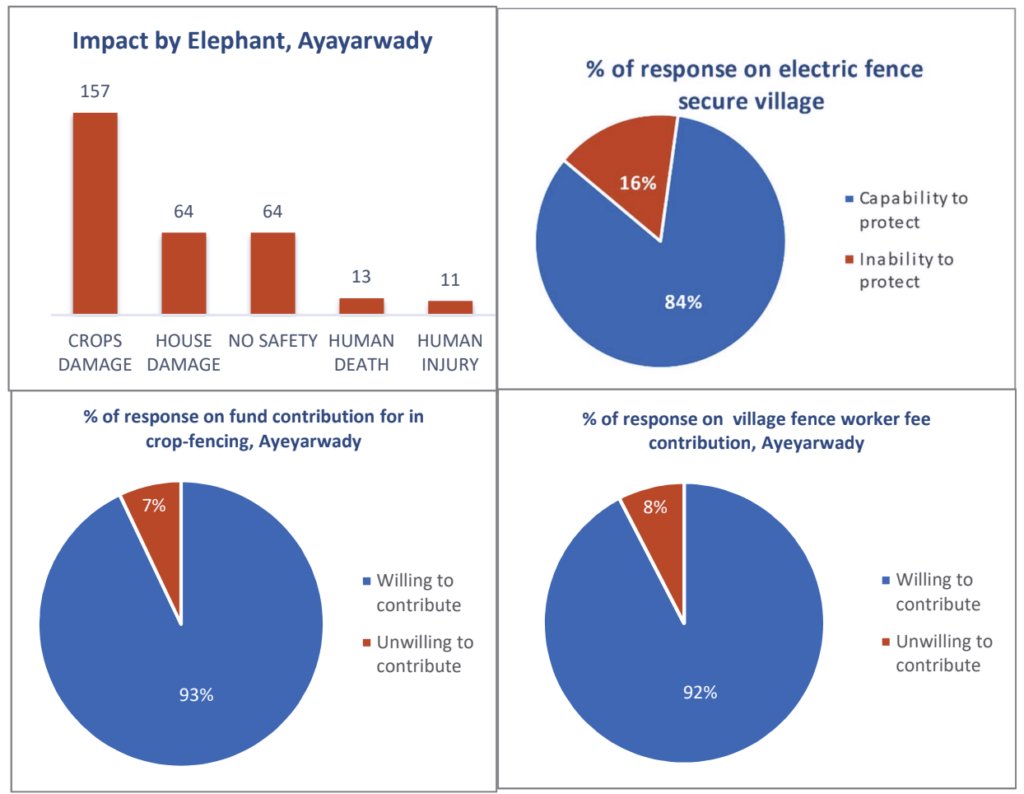
We interviewed 201 fence training participants in Ayeyarwady region, 22 female and 179 male, similar numbers to that of Yangon in terms of sample rate and level of reliability. The respondents reported that the elephants were a main problem primarily and due to damages to crops by the elephants, followed by perceived safety, and damaged to houses, and death and injury respectively. There was a mixture of views in mitigating such negative impacts. Some of the respondents reported that electric fences would secure their villages and assets. Others wanted the elephants removed and the remaining wanted to resolve the elephant entirely. An overwhelming majority of the respondents agreed that electric fence would secure their villages and assets and were willing to contribute funds for such measures and contribute their labor. Villagers showed more confidence in the potential of fences than in Yangon with 84% and up to 93% indicated readiness to contribute personally.
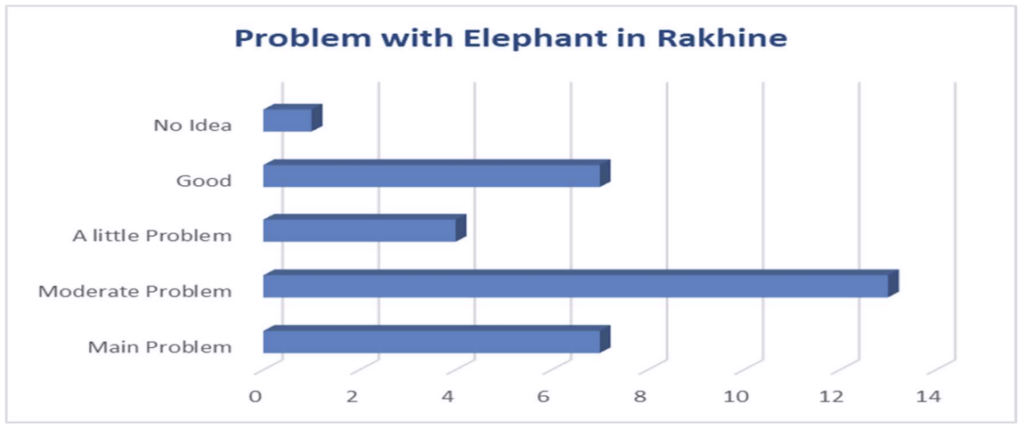
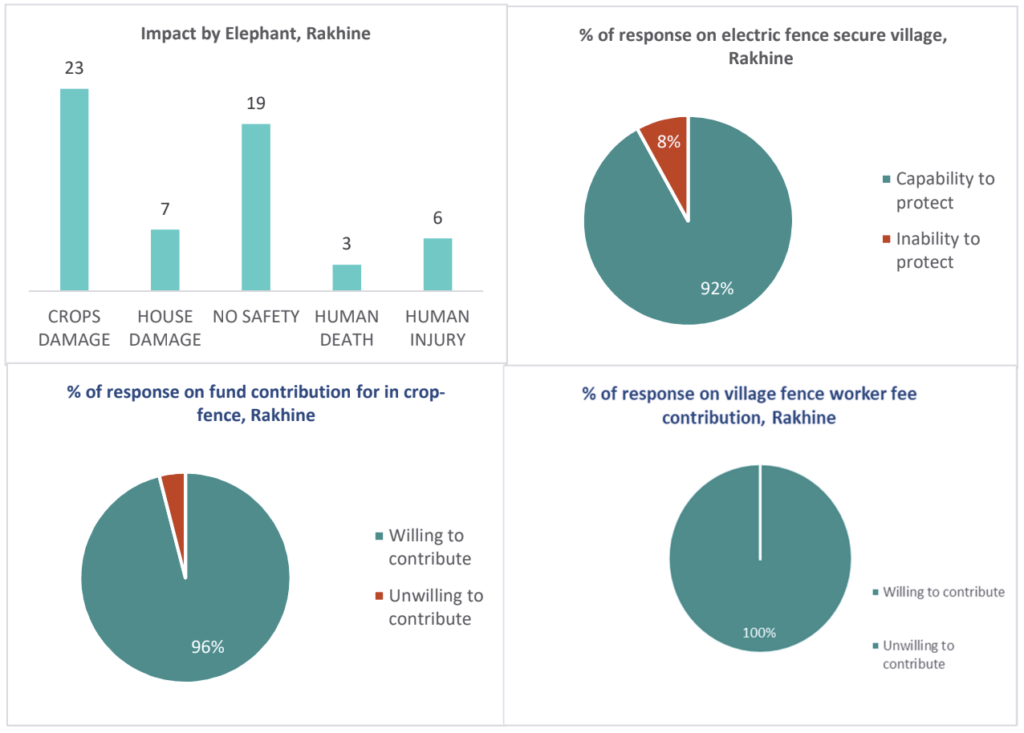
The number of interviews conducted for Rakhine region were only 25 respondents, of which all were men. These surveys produced the highest degree of positive responses compared to that of Yangon and Ayeyarwady. The respondents similarly ranked that elephants were a moderate problem and the damages caused by the elephants were primarily damage to crops, followed by perceived safety, damage to houses and death. In order to mitigate these negative impacts, they fully agreed that electric fences would secure their villages and assets and they were willing to contribute funds for such measures and their labor. 92% had confidence in the fences providing a solution and up to 100% reported readiness to contribute. We need to consider that sample size in Rakhine was smaller because training and fencing activity just started, so reliability of the survey is lower compared to the other two regions.
Crop yield data
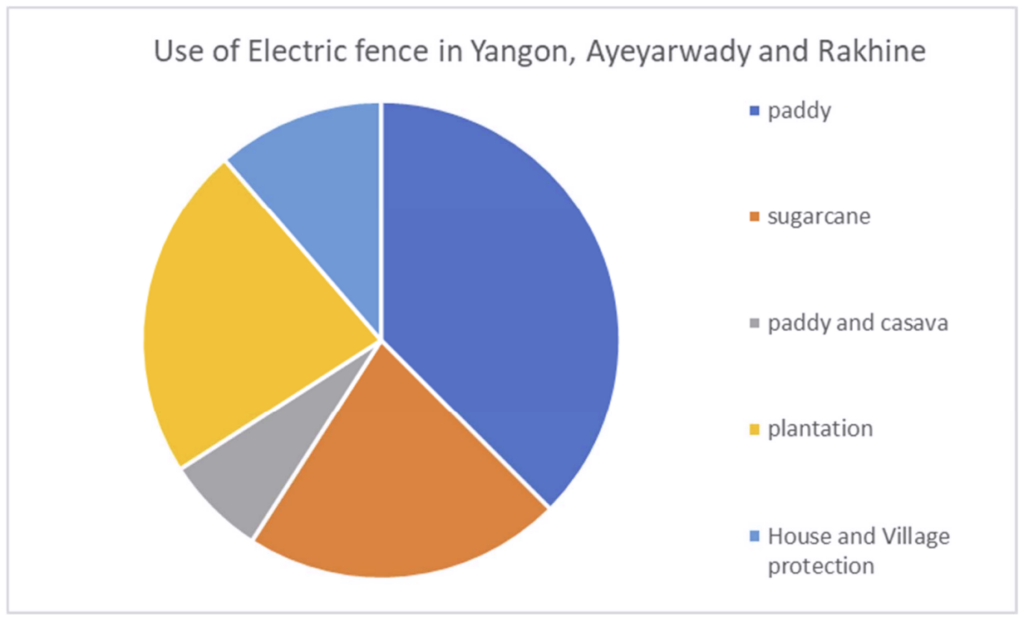
From 2021 to 2024, after 30 fence trainings, a total of 88 fence sites: paddy 33, sugarcane 19, cassava 6, plantation 20, house and village protection 10 are in use in Yangon, Bago, Ayeyarwady and Rakhine and 3 government fences and 8 community fences are in progress.
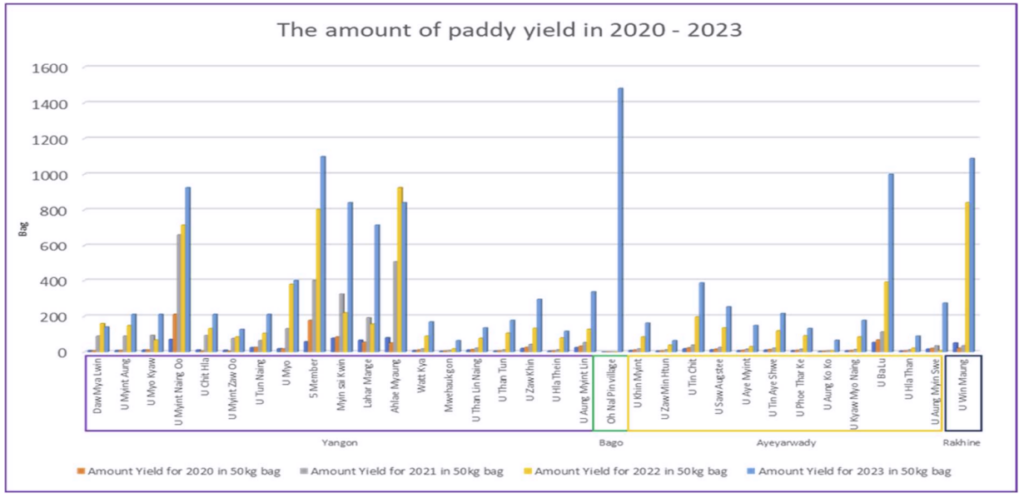
Comparing the yields before setting up a temporary crop fence and after shows that both paddy farmers and sugarcane farmers reported an average increase of their yield of 91% for paddy farmers and 63% sugarcane farmers in both Yangon and Ayeyarwady region. This is a substantial improvement of their livelihood difficult to match by almost any existing means. Most farmers recover the cost of the fence within the first year already, except the smallest, who require several years before breaking even.
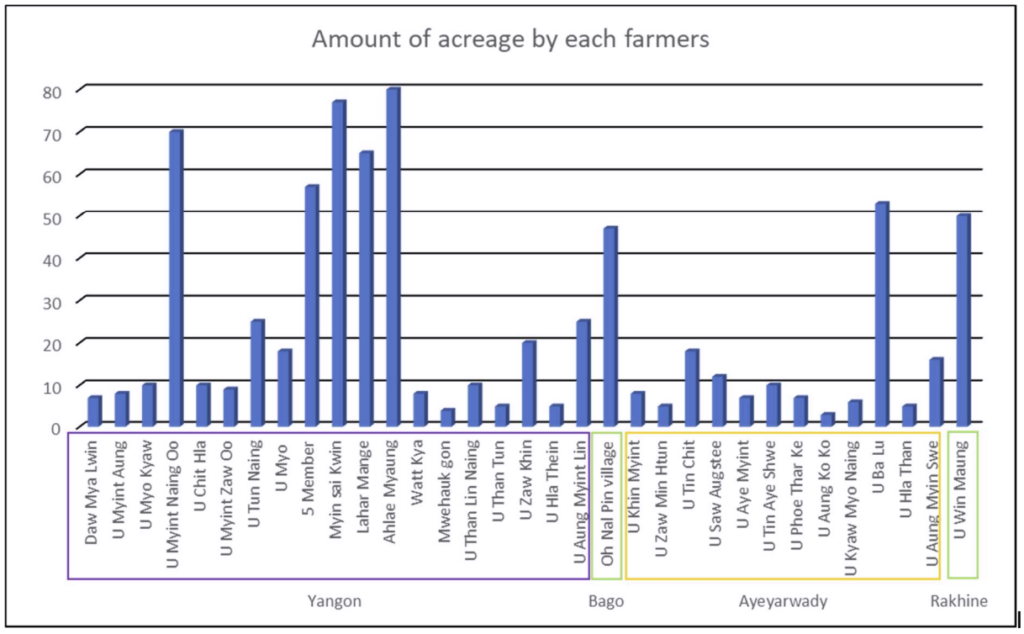
Before the temporary electric fence technique was introduce in 2020, some area were unable to get any harvest at all due to wild elephant destroying their crops and the rate of poaching elephants was high. Nowadays, fence training continues and the farmer’s implementation more and more fences in their fields. In some areas the amount of yield was doubled even tripled, while the poaching was reduced dramatically as well. Farmers who do not lose any more c crops to elephants have collude less with poachers, and rather look for stability and report suspected poachers to the authorities. For example, in Oh Nal Pin village farmers were facing elephants each year which forced them to abandon their fields for several years. After receiving fence training in July by the GBP/H.EL.P. team in September 2022, they purchased and installed a fence and by 2023 the were able to produce 1,500 bags (50kg per bag) of paddy for first time within six years. Their farmland is exceptionally fertile and yields are 3 times above average. No elephant entered their rice field in 2023.
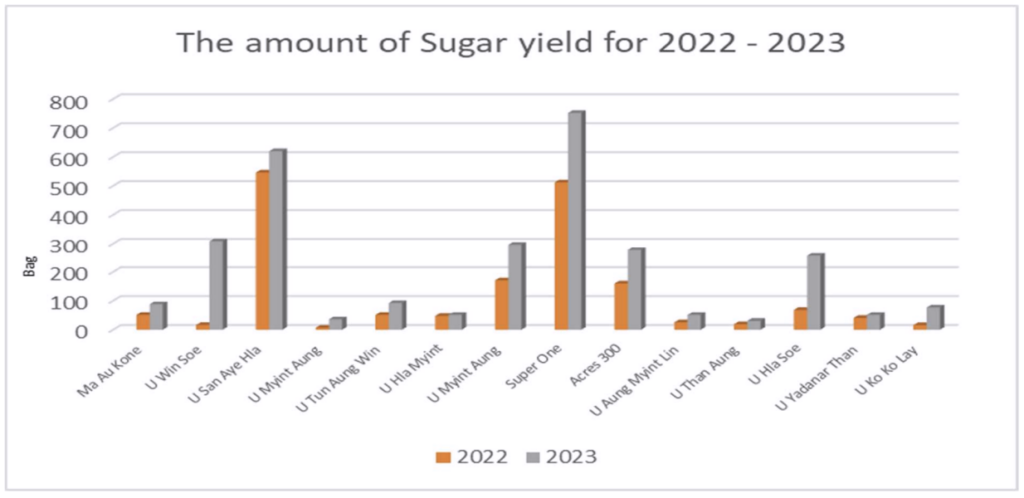
In Yangon region, some farmers grow sugarcane and their average yield and income increased from the first year when they had no fence to the second year when they used a fence by 2% to a maximum of 66%.
Monitoring and elephant sightings and fence maintenance log
Much of the previously presented data was obtained from villagers while conducting bimonthly fence monitoring patrol and inspection visits to all 99 fence sites. The monitoring was carried out jointly by GBP staff, FD and EERU fence trainers and 4 students who actively participate in the data gathering process and will integrate findings in their studies.
In Year 3 from 1 April 2023 till 31st March 2024 a total of 556 fence monitoring trips were conducted in the divisions of Yangon Ayeyarwady and Bago. 539 elephant sightings at or near fences occurred were reported by farmers, of which 271 involved a direct physical contact by the elephant with the fence by touching it. Elephants entered fences 137 times in Yangon region, compared to only 17 times in Ayeyarwady and 11 times in Bago, total 165. Even considering the 3.5 times higher monitoring rate in Yangon still double as many incursions occurred in Yangon than in Ayeyarwady. Most elephant incursions are explained by lack of maintenance on the days the elephants entered. Ayeyarwady farmers have a more rigorous attitude to fence maintenance leading to a higher confidence rate of 84 % by farmers to trust fences for protection, while only 56% in Yangon only confidence rate. Despite the many more incursions in Yangon, crop damage was comparatively low, which indicates that crop guarding in addition to using fences was carried out more effectively in Yangon with only 34 crop damages inside the fence compared to 34 in Ayeyarwady, despite the higher number of incursions Crop damage on 60 occasions total inside the fences was negligible, and farmers were able to improve their yield by using the fences at an average of 91% for rice and 63% for rice crops. Property damage only occurred twice in Yangon. Fence maintenance will need to be reviewed with farmers in Yangon. We will share the findings of this report with the local leaders and fence owners to emphasize the comparison of the various maintenance performances and shortcomings to boost their motivation to improve in coming years.

2.6 Response to the fence training program has been overwhelmingly positive and we reached our initial target of 30 community fences by project end already in 2022. By end of March 2024, 88 community crop fences and 3 government fences at the elephant hospital in Bago, orphaned elephant camp in Bago and the white elephant sanctuary in Yangon were erected under the program. An additional 8 community fences are in the process of being set up, for a total of 99 fences. This represents and overachievement by almost 500% of the initial target of 15 community fences due to overwhelming positive response by communities. See annex for List of fences with location, size, and yield.
CF and GBP creates income opportunities through fence training for individual farmers or group of farmers by teaching them how to use crop fences. They can either provide a service to other farmers, or simply set up their own fence and improve their own crop yield substantially. After positive cost benefit calculations which determines if sufficient crops are destroyed annually to justify the investment, the community install the fence paying for all materials.
3. Building Capacity
3.1 Three students from Pathein University regularly join monitoring patrols in four regions of Ayeyarwady, Tharpaung, Chaung Thar, Ngwe Hsaung and Nga Pu Taw. They collect project monitoring data and enter it into our GBP online databased. Chairman of GBP gave a lecture and training during 24th training at Chaung Thar Township, Kangyi village. BAT team Belinda Stuart Cox and Keith Lindsey held a M&E review and refresher in Chiang Mai Thailand with GBP director Aung Myo Chit and GBP M&E data manger in February 2024.
3.2 see 1.7
3.3 see 1.6
3.4 see 1.7
3.5 see 2.6
Response from trainees was so overwhelmingly positive, that instead of the estimated 15 community fences to be established, at present we are at 88 fences in seasonal operation which is a 500% increase.
3.6 see 2.5
3.7 A total of 649 patrol and monitoring trips were carried out on 122 days in Y3 and maintenance advice was provided on 65 occasions to fence owners.
3.8 same as 1.7 and 2.5
See annex for maps of fence areas and elephant sighting locations.
3.9 GBP and Compass Films prepared a M&E report to collate all the M&E data and more. Quarterly reports were provided throughout Year 3 to BAT.
4. Sharing Knowledge
4.1 Compass Films and GBP discussed Media Strategy 26 Mar2024 via WhatsApp. Due to political tensions broadcasts on National TV are still off limits, but Face Book was determined as the best option to disseminate information about the program at the moment. Additional videos will be edited for use on Facebook and during workshops about electric fencing.
4.2 same as 4.1
4.3 GBP posted average weekly on Facebook, see sample posts and list of all posts and dates in the following pages. Surprisingly 52% of all Facebook visits were from India, Myanmar 2nd
Facebook upload screenshots
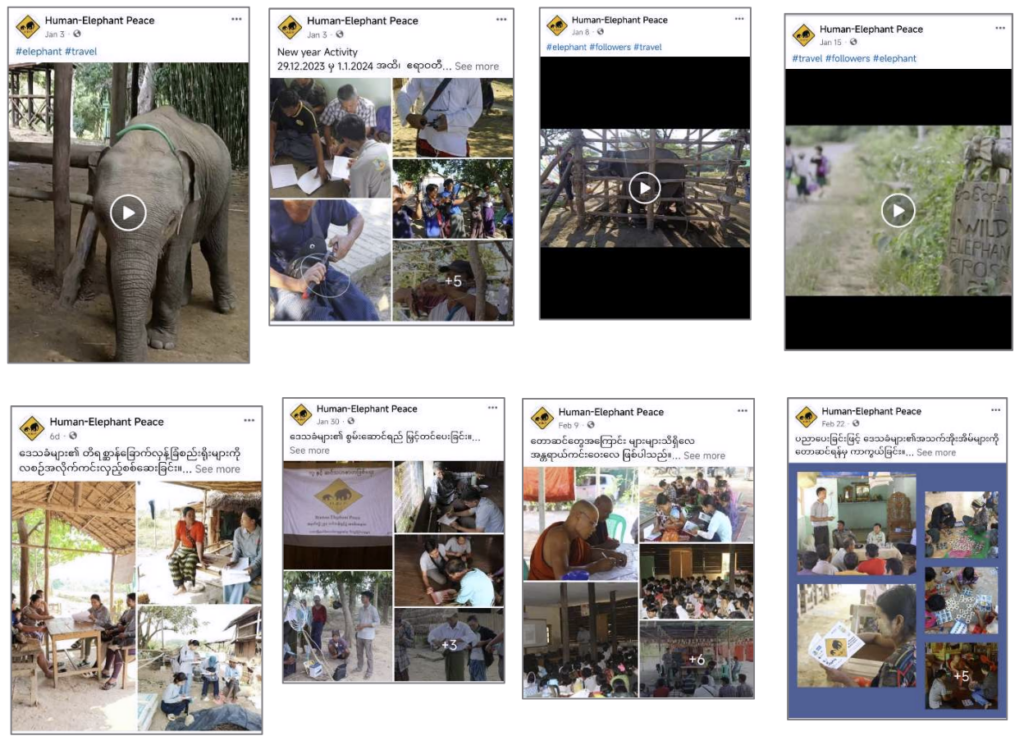
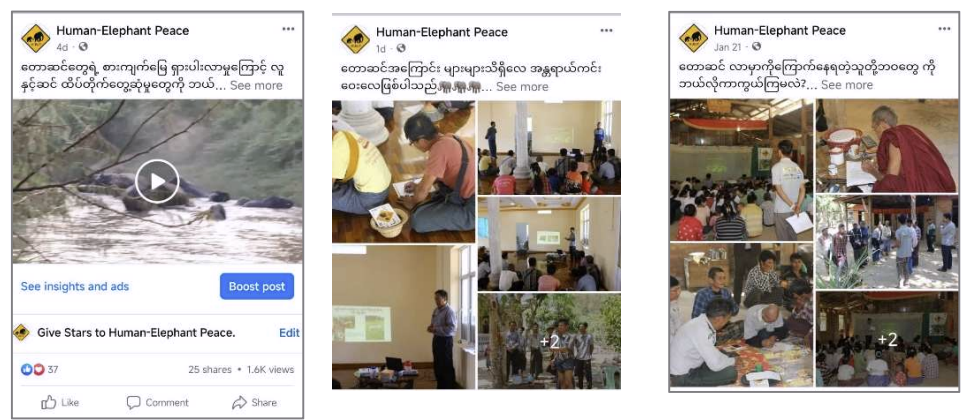
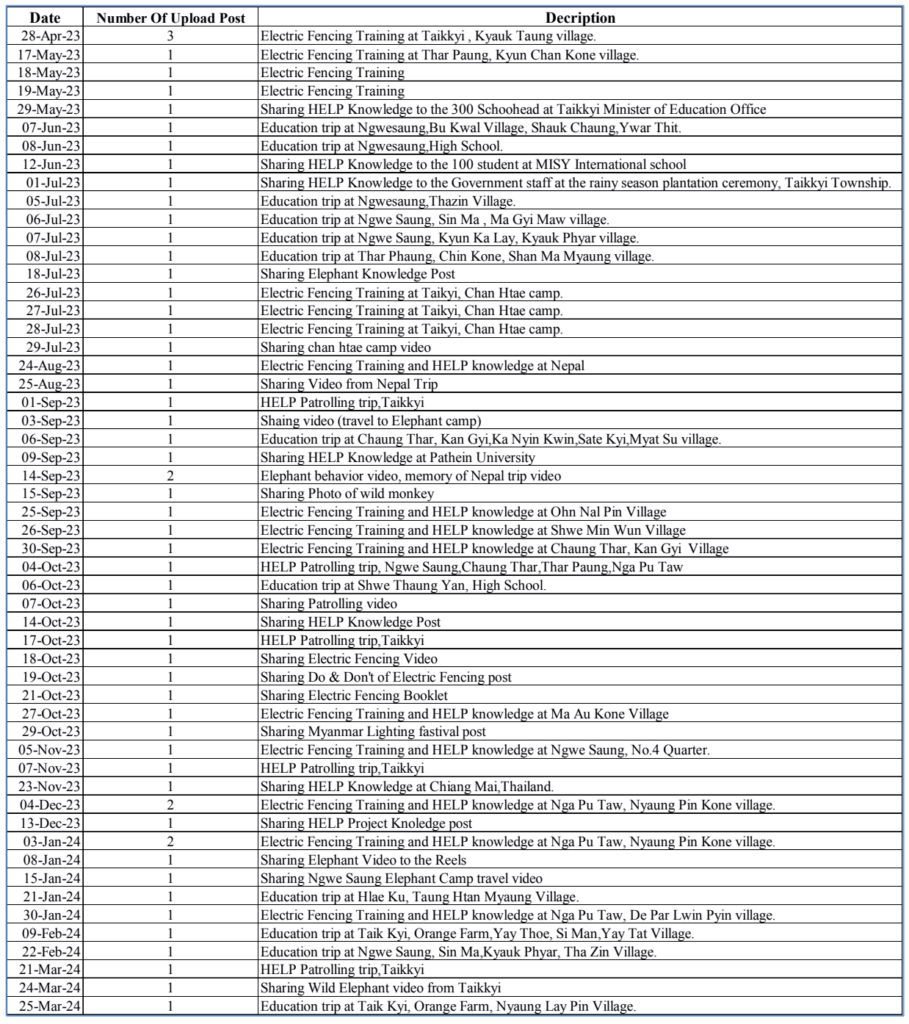
4.4 Project findings are shared via Facebook with communities throughout the year and monitoring teams share updates and information with villagers during each monitoring trip.
4.5 Throughout the year 22 meetings where held with officials about the H.EL.P. project to further their understanding of our goals and objectives. See list below
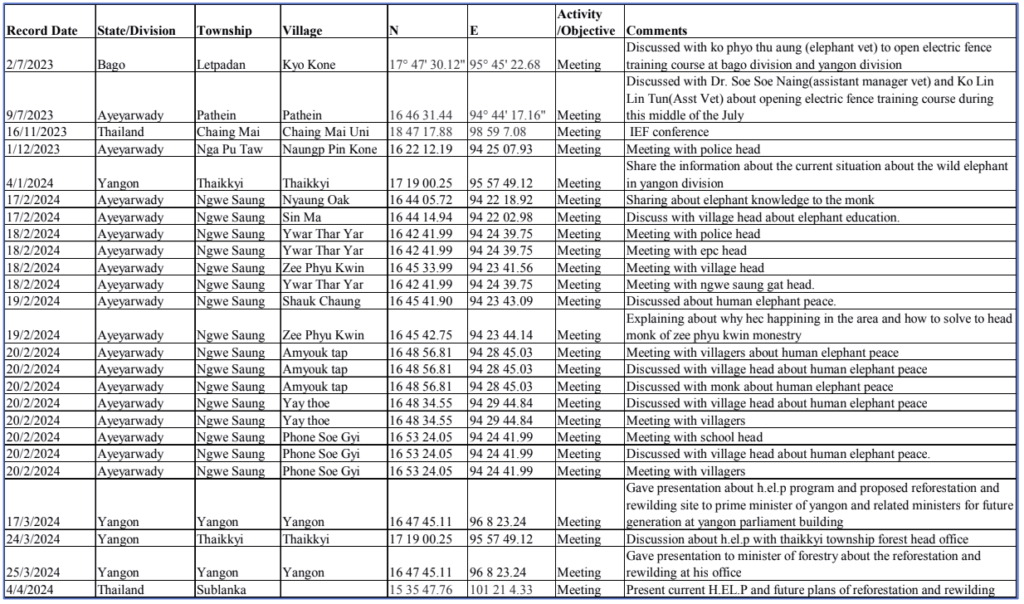
4.6 On Mar 23, BAT’s Belinda Stewart Cox gave a project presentations to the Asian Elephant Specialist Group conference and Asian Elephant Conservation Group workshop in India on behalf of AMC.
GBP director and GBP Chief electrician and Education team leader with Klaus Reisinger Compass Films held a 10 day pilot H.EL.P. fence training pilot workshop, trained 26 government officials and villager and installed 2 pilot fences with villagers in collaboration with Ujyalo Nepal on a USFWS match funding activity. This program was a success and the Myanmar program is in the process of being replicated as H.EL.P. Nepal in Bardia in 2024.
GBP director Aung Myo Chit gave an international presentation at IEF International Elephant Foundation Symposium in Chiang Mai Thailand on the 16th November 2023.
GBP director Aung Myo Chit and Klaus Reisinger Compass Films represented Myanmar at the Elephant Rewilding Workshop – Laos Thailand – Myanmar held at Sublanka Elephant Reserve-Thailand on 2-5 April 2024. Aung Myo Chit presented the H.EL.P. program activities and future plans on extending the program to habitat restauration and rewilding.