Executive Summary
This report describes the fencing trainings conducted, GPB fence sites and their locations and types, private fence sites and their locations and respective elements, the number and description of regular petrol trips carried out, and elephants’ death. In terms of the fencing training, 10 trainings with total of 157 participants were held in Yangon Region and Ayeyarwaddy Region in 2020-2022. The average participants of each training were 16, and the average female participants was three. Of all participants, nearly 20 percent were women. A total of 17 GBP fence sites are widespread in Bago, Yangon, and Ayeyarwaddy installed starting from 2017 until 2022. Of these, approximately 76% are in Yangon Region and 12% each in Bago and Ayeywarwaddy Regions. These GBP fence sites can be mainly classified into permanent and seasonal. Few can be categorized as others based on situation encountered. All seasonals are only found in Taikkyi Township of Yangon Region, but permanents are dispersed in all three regions. While permanents need to be installed once, seasonals need to be installed, removed, and reinstalled depending on season/time.
For the matter of private fence sites, all 27 private fence sites are owed by individuals, constructed starting from 2015, and are located in Taikkyi Township. These sites cover 1020 acres in total and are used for protecting several matters, such as forest plantations, sugarcane, tapioca, mixed forest plantations, and many others. Regarding energizers, four types energizers, Thai energizer, Chinese energizer, TH-MARS, and Inverter were used on the sites: Thai energizer was the most used, followed by Chinese energizer and TH-MARS, while Invertor covered only one acre.Out of 27 individuals, 11 were GBP trainees. With a combination between GPB fence sites and private fence sites, 88% of fences are located Yangon region and there is no private fence sites outside Yangon region. Moving to regular patrol trips, 270 visits were carried out from mid 2020 to the third quarter of 2022 almost a monthly basis. Despite a number of purposes occurred, a combination of “regular monitoring” and “monitor the device and fence” purposes represented a huge percentage of all visits and the trend of these two combined was dispersed in every month that the visit has. From the aspect of the actions taken, there were dozens of actions that were taken in all trips. However, the two specific actions:
- collect, check the fence situation, elephant movement and meeting with farmers and
- collect fencing forms, EERU team, GBP team were the lion’s share among all actions were taken and these two actions were especially taken when the visits carried out with the purpose of two above-mentioned purposes respectively.
In terms of elephant death, the record shows that 5 elephants died during 2022. One was killed, the other one was natural death, and the causes of the rest dead ones were not described.
Fencing trainings
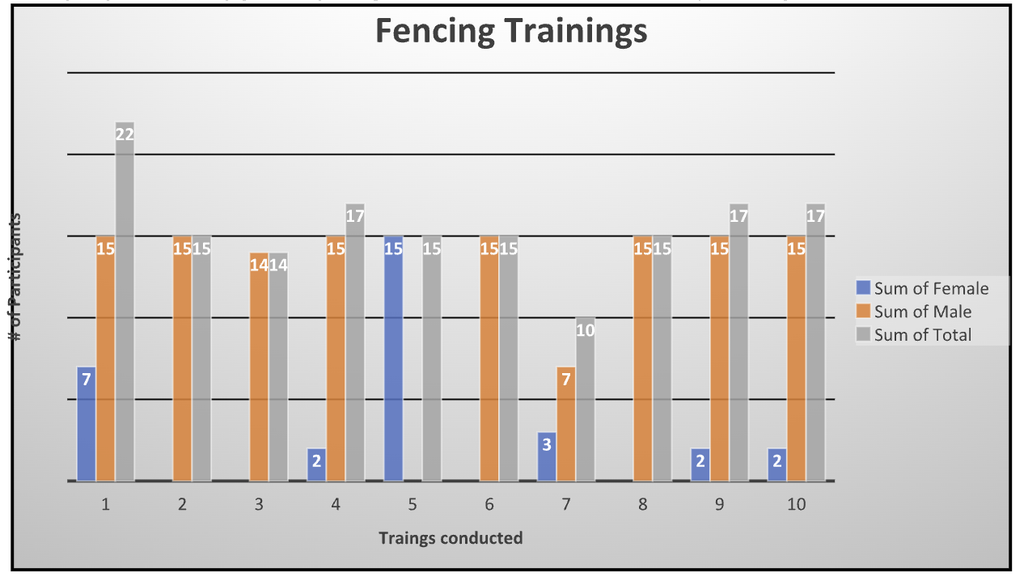
From late 2020 to mid-2022, 10 four-day electric fence trainings were conducted in 10 villages of four townships: Ngaputaw and Ngwehsaung Townships in Ayeyarwaddy Region, and Oakkan and Taikkyi Townships in Yangon Region. Of the 157 total participants who joined in the 10 trainings, 31 were female, and 126 were male. A total of 68 participants, including seven female (10% of participants), joined the four different trainings held in Ayeyarwaddy Region, while 89 participants, including 22 female (25%), joined the six trainings held in Yangon Region. At one training held in Oakkan Township, Yangon Region all 15 participants were female.
FENCING TRAININGS BY TOWNSHIP AND DATE WITH PARTICIPANTS
MAP OF TRAININGS’ LOCATIONS
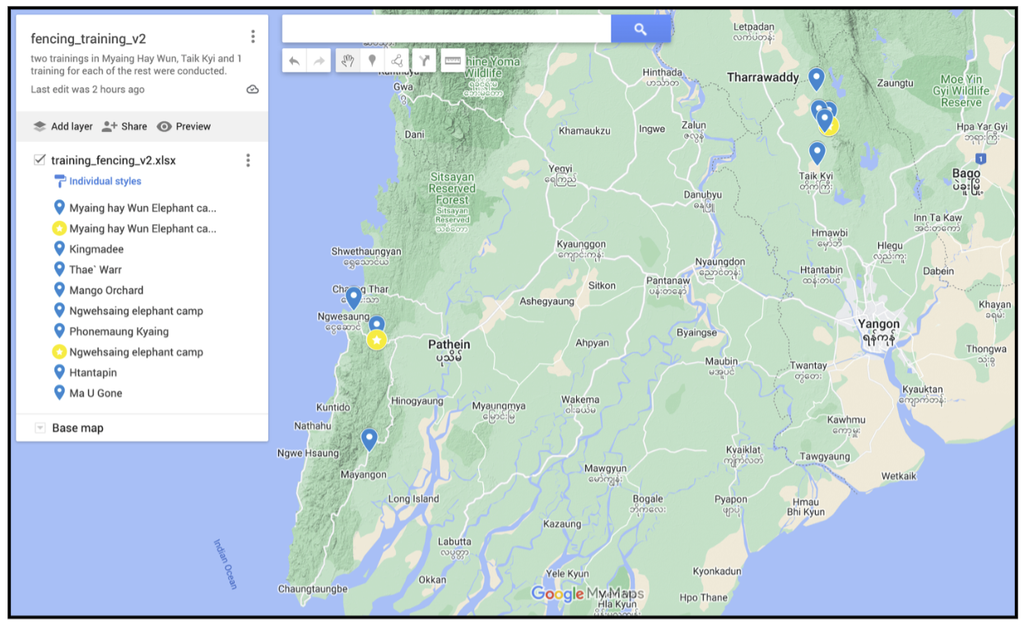
The first training was carried out in late 2020 at Myaing Hay Wun Elephant Camp in Taikkyi Township, which all male 17 participants (15 males and 2 females) attended. In 2021, two trainings were conducted at Myaning Hay Wun Elephant Camp and Kingmadee Elephant Camp in Taikkyi Township with 27 participants between (22 males and 5 females). From early to mid-2022, seven trainings were completed – one each at Tae’ War and Mango Orchard in Taikkyi Township, Ma U Gone in Oakkan Township, Phonemaung Kyaing in Ngwehsaung Township, and Ngapu Taw Township and two trainings at Ngwehsaing Elephant Camp – in which 113 participants in total joined (89 males and 26 females).
GBP fence sites
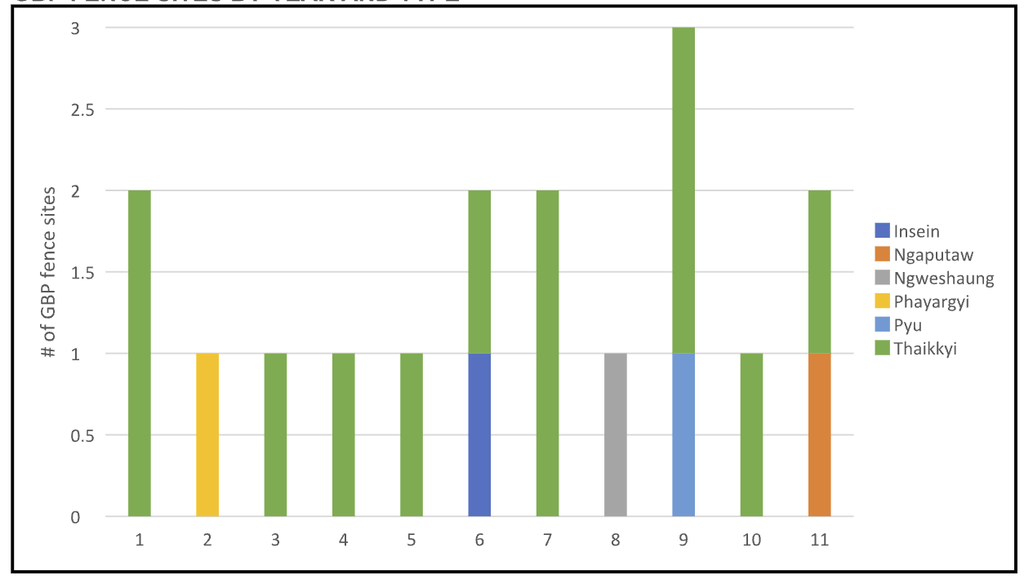
For the GBP fence sites, there have been 17 GBP fence sites in three regions between 2017 and 2022: Bago, Yangon and Ayeyarwaddy. Yangon Region has the most of these sites with 13 sites, while Bago and Ayeyarwaddy Regions have two sites each. GBP fence sties can be generally categorized as seasonal and permanent. Apart from that, two sites were categorized as house fence that they use after paddy season and no caption as the village was destroyed by coup. All seven seasonal fence sites are located in Taikkyi Township. Four of the eight permanent fence sites are also located in Taikkyi Township, with the rest dispersed with one each in Insein, Ngaputaw, Pharyargyi, and Phyu Townships. One site used as house fence (type) after the paddy season is located in Nwgehsaung Township and the rest one located in Taikkyi Township has been destroyed by the coup.
GBP FENCE SITES BY YEAR AND TYPE
MAP OF GBP FENCE SITES CLASSIFIED BY THE TYPES OF FENCE SITES
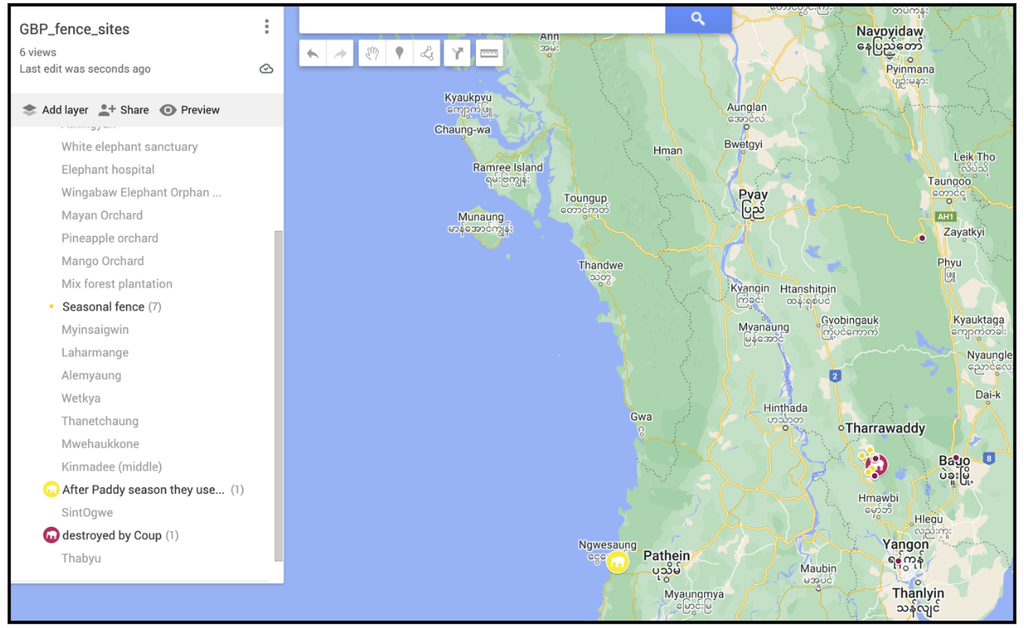
Four of the seasonal fences were installed during in the Q3 of 2020 and were removed at the beginning of 2021 for the first time, to be reinstalled around 2021 Q3. The other three seasonal fences were first installed during Q3 of 2021. All were removed during the first months of 2022 and again reinstalled during Q3 of 2022, with the exception of one site in Thanutcaung. That one remains removed. Once fence at SingOgwe site in Ngweshaung Township, Ayeyarwaddy Region, is used as a house fence after paddy season, which stands out as a separate type of fencing, and was installed during the last quarter of 2021. Lastly, Tabyu site located in Takikyi Township, Yagon Region, was installed in the first of 2021 Q3, but as its village was destroyed by the coup, this site is regarded as outside of the three above-mentioned GBP types: permanent, seasonal, and used for house fence.
Private fence sites
In addition to the 17 GBP fences, there are 27 private fence sites owned by 27 separate individuals in 15 villages of seven village tracts in Taikkyi Township, Yangon Region. The first of these fences was started in 2015, while the rest were started with an upward trend between 2020 and 2022, with two sites in 2020, four in 2021, and 19 in 2022. Among the 27 individuals, 11 are GBP trainees, seven of whom are from Panlone Village tract with the other four from four different village tracts. Meanwhile, the starting time and exact location of the site from Thanatchaung Village tract has not been recorded.
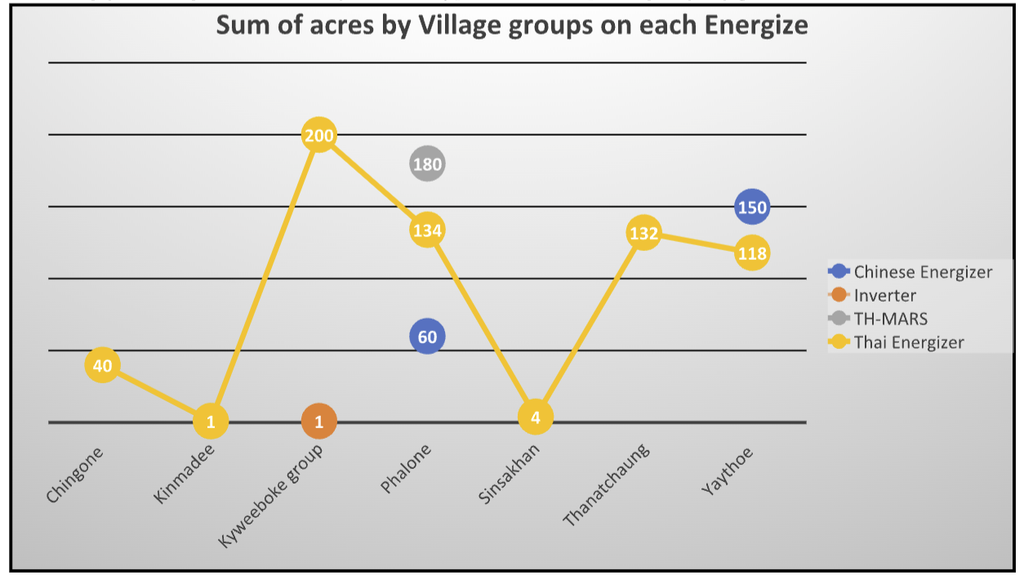
AREA COVERAGE BY TYPE OF ENERGIZER AND VILLAGE GROUP
MAP OF PRIVATE FENCE SITES
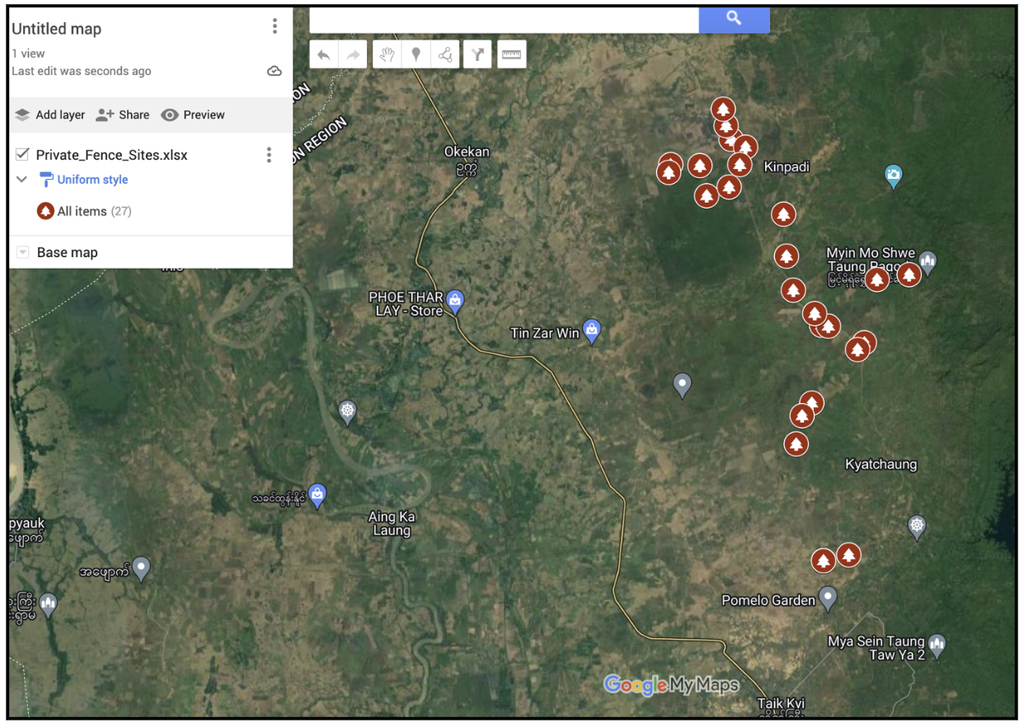
As far as the location of sites, Phalone Village tract has the highest number of sites at 11. Kyweeboke and Yaythoe Village tracts have the second highest with 5 sites each, followed by Thanatchaung Village tract with 3 sites, with Kinamee, Chingone, and Sinsakhan Village tracts with one site each. These private fence sites cover 1020 acres total: eight sites cover 374 acres of Phalone Village tract, four sites cover 268 acres of 4 Yaythoe village tract , five sites cover 201 acres of Kyweeboke village tract, three sites cover 132 acres of Thannatchaung village tract, one site covers 40 acres of Chin gone village group, one site covers four acres of Sinsakhan village group and 1 site covers one acre of Kinmadee village tract. Of those 1020 acres protected by private fences, more than 840 are covered by four land types: forest plantation, sugarcane, tapioca, and mixed forest planation. The other 180 acres are covered by many other land types, including the combination of aforementioned ones. For energizer, 22 private fence sites covering 629 acres use Thai energizer, while two sites covering 210 acres use Chinese energizer. Furthermore, another two sites covering 180 acres use TH-MARS, and the final site covering one acre uses Inverter.
Regular patrol trips
From June 2020 through September 2022, patrol trips were mostly conducted on a monthly basis to reach a cumulative 270 visits in that time. No patrol trips were performed on the month of February 2021 and few trips were done in the following two months. In September 2021, no trip could be made again. The chart shows a peak in visits in May 2021 with 23 visits and a period of highest trend in the May – October part of that year with a total of 92 visits, representing 34% visits over the whole 30 months visits. Note that February and September 2021 have been left off the chart because of no visits in those months.
REGULAR PATROL TRIPS BY MONTH & MOVING AVERAGE TREND
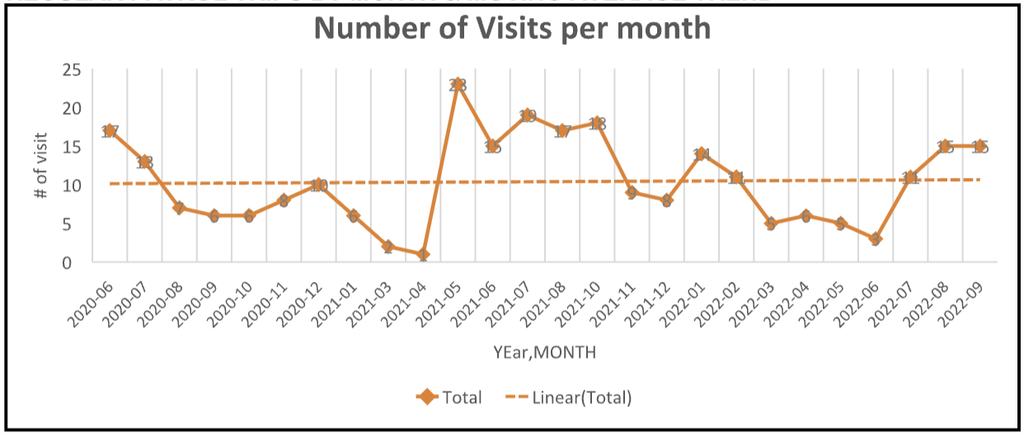
According to moving average trend, it reveals that there has been some degree of fluctuation over the 30-month period. Q1 of 2021 saw a significant decrease from the second half of 2020. Visits rose again in mid-2021, dipped during the Q2 of 2022, and grew again during the last three months of the visits. The purpose of patrol trips can vary significantly, but more than 60% of the trips were to monitor the device and fence and to perform regular monitoring. Trips with these purposes were evenly distributed throughout the 30 months’ duration, and the trend of the visits with these two purposes resembles to that of the total visits over time.
REGULAR PATROL VISITS BY TWO PARTICULAR PURPOSES FOR TWO PARTICULAR ACTIONS TAKEN
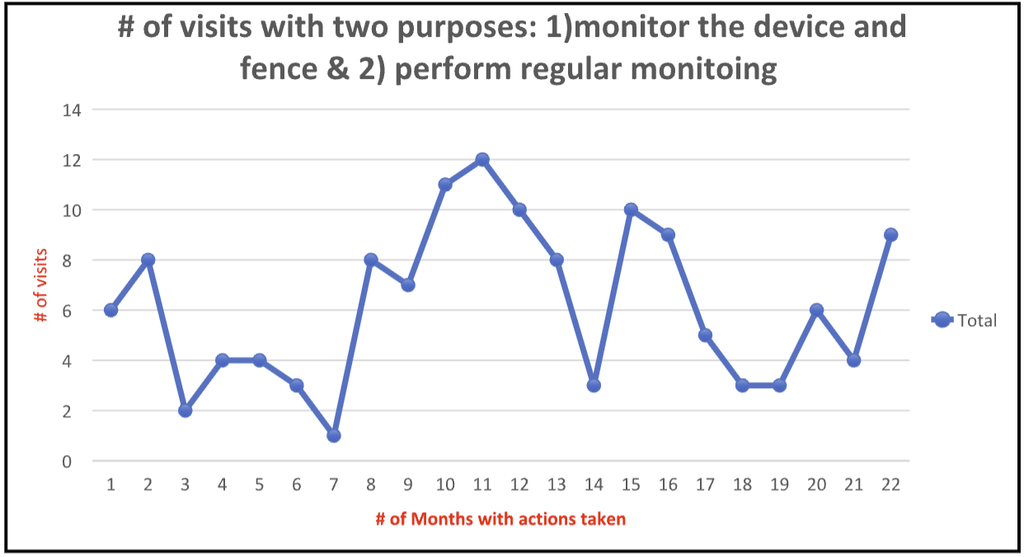
Although the reasons for visits varied, two actions occupied 55% of trips:
- collect, check the fence situation and elephant movement, and meet with farmers, and
- collect fencing forms, EERU team, GBP team.
The visits for these two purposes occurred every month that the visit(s) were made, and the pattern for their frequency is similar to that of the visits with two above- mentioned purposes and that of the total visits over time. Consequently, out of 148 total visits which these two aforementioned actions were taken, 136 visits (91%) were conducted for the two above-mentioned purposes. The above graph shows the number of total visits with these two actions taken that was conducted for these two above-mentioned purposes.
Elephants’ Death
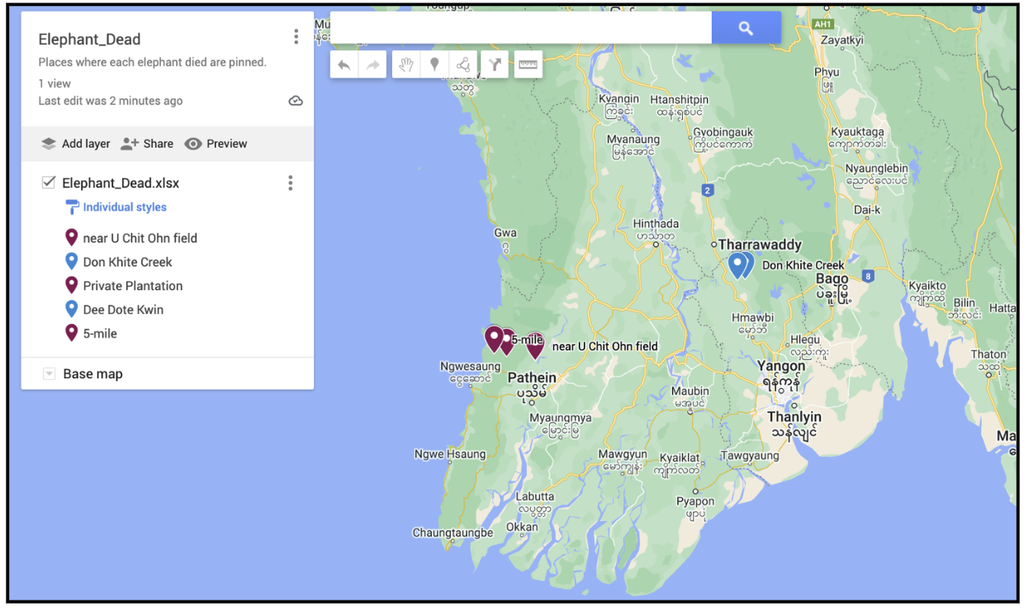
Five elephants died during the first three quarters of 2022 in four different townships: Thar Paung, Chaung Thar, and Shwe Thaungyan Townships in Ayeyarwaddy Region and Taikkyi Township in Yangon Region. One elephant of 35 years at 5-mile location in Shwe Thaungyuan Township was reportedly killed with a poisoned arrow, and the tusks were cut out from the root. MTE said that a wild elephant was found dead and bloat condition near U Chit Ohn field in Thar Paung Township. Another elephant death at a private plantation in Chaung Thar Township was reported to Aung Myo Chit by plantation owner. In Taikkyi Township, one elephant that died at Dee Dote Kwin was reported to EERU and another natural death of L 3’3″, Foot 1′, Tall 2’1″, Tail 5″ (baby elephant?) was acknowledged by Governor U Aung Kyaw Moe, U Tun Zin Khine, U Khin Maung Win (100 Household Head), U Nyein Maung (10 Household Head).
MAP PINNING THE LOCATIONS OF ELEPHANTS’ DEATH